


The DeMo-Planet project
"Modelling of crustal deformation caused by magma intrusion on terrestrial planetary bodies"
DeMo-Planet is a collaboration between researchers at the Space Research Centre PAS, and other experts from Poland, Ireland, France and Norway. It is a POLS project funded by the Norwegian Financial Mechanism at the National Science Centre of Poland (NCN Poland). The principle investigator Dr. Sam Poppe was also a recipient of a ULAM postdoctoral fellowship from the Polish National Agency for Academic Exchange (NAWA).
The project ran from August 2021 until the end of 2023.
[PL] DeMo-Planet to współpraca naukowców z Centrum Badań Kosmicznych PAN z ekspertami z Polski, Irlandii, Francji i Norwegii. Jest to projekt POLS finansowany przez Norweski Mechanizm Finansowy z Narodowego Centrum Nauki (NCN Polska). Kierownik dr Sam Poppe był również beneficjentem stypendium podoktorskiego ULAM przyznanego przez Narodową Agencję Wymiany Akademickiej (NAWA). Projekt trwał od sierpnia 2021 r. do końca 2023 r.
Follow us on Facebook and X/Twitter (@SamPVolcano)
Project goals / Cele projektu
The numerical models that we most often use to simulate intrusions of molten, liquid rocks, or "magma", oversimplify the complex response of the rocks in the crust of Earth, the Moon and Mars. This leads to mischaracterisation of the size, shape and position of magma bodies below the surface. On Earth, those misestimates can have far-reaching consequences for how we forecast volcanic eruptions, on other rocky planets we can end up with a poor view of past volcanism.
The DeMo-planet team has used the Distinct-Element Method (DEM) to simulate complex straining and fracturing caused by the injection of stiff magma. We used geological observations from magma intrusions in quarries in the Sudetes region in Lower-Silesia in Poland. Those late-Permian trachy-andesite intrusions (yes, they´re older than the dinosaurs!) are remarkably similar to some of those assumed to have intruded in the lunar and Martian crusts. By using drone-based photogrammetry and laboratory experiments on rock samples from the quarries we could document the deformation features and mechanical strength of the host rocks deformed by these intrusions. This field case has helped tremendously to verify our numerical model. This way, DeMo-Planet research has helped better understand how once-liquid magma may have deformed the surface of the Moon and Mars during their volcanic history.
[PL] Modele numeryczne, których najczęściej używamy do symulacji intruzji stopionych, płynnych skał lub "magmy", nadmiernie upraszczają złożoną reakcję skał w skorupie Ziemi, Księżyca i Marsa. Prowadzi to do błędnego określenia rozmiaru, kształtu i położenia ciał magmowych pod powierzchnią. Na Ziemi te błędne szacunki mogą mieć daleko idące konsekwencje dla sposobu prognozowania erupcji wulkanicznych, na innych planetach skalistych możemy mieć słaby obraz wulkanizmu w przeszłości.
Zespół DeMo-planet wykorzystał metodę elementów odrębnych (DEM) do symulacji złożonych naprężeń i pęknięć spowodowanych injekcją sztywnej magmy. Wykorzystaliśmy obserwacje geologiczne z intruzji magmy w kamieniołomach w regionie Sudetów na Dolnym Śląsku w Polsce. Te późnopermskie intruzje trachy-andezytowe (tak, są starsze niż dinozaury!) są niezwykle podobne do niektórych z tych, które przypuszczalnie intrudowały w skorupę księżycową i marsjańską. Dzięki zastosowaniu fotogrametrii opartej na dronach i eksperymentów laboratoryjnych na próbkach skał z kamieniołomów mogliśmy udokumentować cechy deformacji i wytrzymałość mechaniczną skał macierzystych zdeformowanych przez te intruzje. To studium przypadku bardzo pomogło zweryfikować nasz model numeryczny. W ten sposób badania DeMo-Planet pomogły lepiej zrozumieć, w jaki sposób niegdyś płynna magma mogła zdeformować powierzchnię Księżyca i Marsa podczas ich wulkanicznej historii.
March 2024 - first publication of our scientific results!
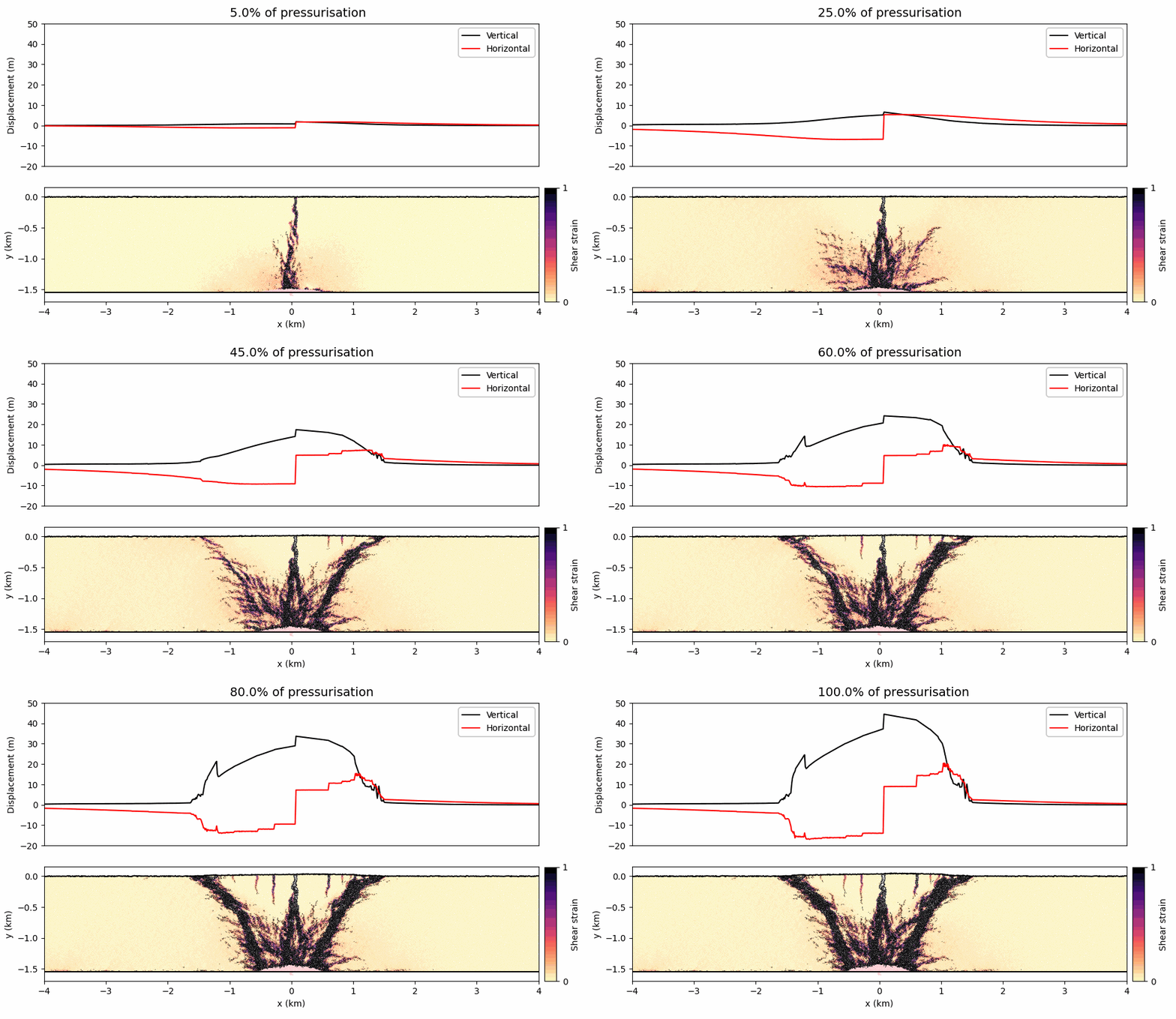
The first peer-reviewed paper on our scientific results, led by DeMo-Planet postdoc dr. Alexandra Morand, is out now in the Journal of Geophysical Research - Solid Earth! Open-access to read for all here! In the paper, we show that the strength of the rocks and the depth at which the magma intrude affect the ground deformation and the fracturing patterns around the intrusion. Our model will help better understand the limitations of often-used, more simple models.
Below is a teaser of the two endmember deformation patterns that we simulated.
[PL] Pierwszy recenzowany artykuł na temat naszych wyników naukowych, prowadzony przez postdoc DeMo-Planet dr Alexandrę Morand, ukazał się w Journal of Geophysical Research - Solid Earth! Otwarty dostęp dla wszystkich tutaj! W artykule pokazujemy, że wytrzymałość skał i głębokość intruzji magmy wpływają na deformację gruntu i wzorce pękania wokół intruzji. Nasz model pomoże lepiej zrozumieć ograniczenia często stosowanych, prostszych modeli.
Powyżej znajduje się zwiastun dwóch symulowanych przez nas wzorów deformacji elementu końcowego.
End of 2023 - research summary
The project has ended officially at the end of 2023. But we will continue publishing the exciting results! We published a research summary with Scientia.org that walks through the research that led up to the DeMo-Planet project. Read our summary here!
[PL] Projekt oficjalnie zakończył się pod koniec 2023 roku. Będziemy jednak nadal publikować jego ekscytujące wyniki! Opublikowaliśmy podsumowanie badań w Scientia.org, które omawia badania, które doprowadziły do powstania projektu DeMo-Planet. Przeczytaj nasze podsumowanie tutaj!
October 2021
P.I. Dr. Sam Poppe presented the project aims at SRC PAS. Learn more on YouTube!
[PL] Kierownik dr Sam Poppe zaprezentował cele projektu w CBK PAN. Dowiedz się więcej na YouTube!
Meet the DeMo-Planet collaborators!

Principle Investigator (P.I.)
Dr. Sam Poppe
CBK PAN
Poland


Collaborator - Petrology
Prof. Dr. Hab. Marek Awdankiewicz
University of Wrocław
Poland


